
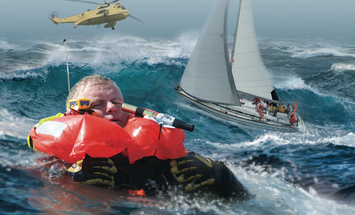
Posted by Jeff Dusting on 20th Jun 2014
Fitting AIS and Locator Beacons to Your PFD

Personal Locator Beacons (PLB) and Personal AIS devices have decreased in size and price over recent years, making them increasingly popular and bringing a whole new level of personal safety to commercial and recreational marine activity.
It is now possible to:
- Mount your PLB inside your PFD cover so that when it inflates it is there (not in your pocket or worse down below), and when it is activated, the device is secured with the antenna pointing upwards and your hands free.
- Mount an AIS device on the other side so that it automatically deploys when your lifejacket does - creating an immediate alert to all AIS vessels in the area that there is a Man Over Board (MOB)
PLBs
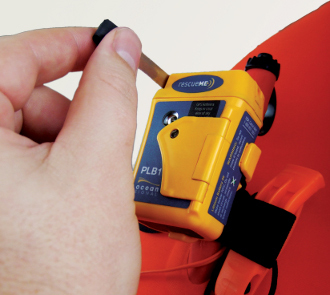
The all new RescueMe PLB from Ocean Signals is the first PLB small enough to install inside the PFD cover - what's more, it now has a 7 year battery life. When installed on an inflated PFD, it is a simple one handed operation to extend the antenna and activate the PLB - we know, we have tested it!
The larger and more well known PLB from ACR - ResQLink+ - is still small and can readily fit inside the external pouch on your deckvest or belt mounted pouch to ensure it is with you when you need it
R10 AIS
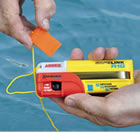
The Kannad R10 AIS device has been tested to integrate with Spinlock Deckvest Lifejackets, the Kru Sport Pro, and many others for automatic deployment. On other PFDs, you can still install them inside the PFD bladder and be sure that they are handy for activation when needed.
To see how the Kannad R10 works, take a look at this short sequence of slides from Kannad.
Kannad have published a document on their own website detailing fitting of a Kannad R10 AIS device into a Deckvest lifejacket. This document can be downloaded from the link below.
Combined PLB / AIS
Everyone asks, when will the combined unit be available ... we don't know, but understand that there are some significant challenges with compatibility between the operating frequencies of the two devices, and the need for the PLB to retain a stored battery capacity while the AIS device is designed for repeated use.
... we are sure a solution is coming, but it could be some way off.